

Machine downtime costs industrial plants thousands of dollars per hour. In automated production environments, broken wiring and severed hydraulic lines cause a massive share of unexpected stoppages. When heavy hydraulic conduits flex constantly or hot chips pelt moving components, basic plastic carriers fail quickly.
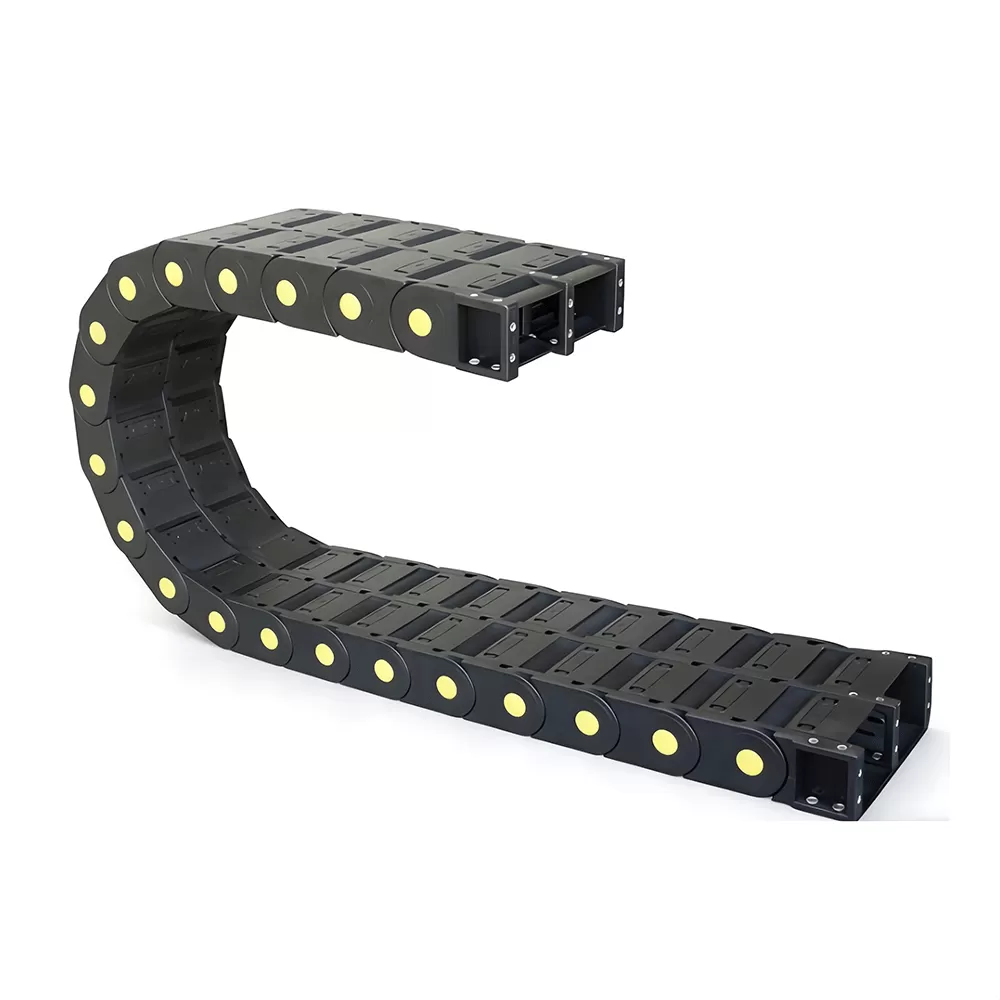
A heavy-duty metal cable drag chain solves this challenge. Built from hardened steel alloys, these carriers shield vital power, data, and fluid lines under demanding conditions. At QUNHUI, we manufacture precision-engineered cable management solutions designed to withstand high mechanical loads, aggressive abrasives, and high-heat processing.
If your machines struggle with premature carrier fatigue, premature line failure, or long-span sagging, this guide covers the engineering criteria you need. Review the technical factors below, or contact QUNHUI directly to request a quote and obtain tailored CAD models for your project.
Why Metal Cable Drag Chains Outperform Plastic in Heavy Automation
Engineers often default to nylon drag chains due to their low purchase cost and light weight. However, standard polymer chains deform under intense heat, crack under mechanical impact, and sag under heavy multi-conductor loads. A steel cable carrier handles stresses that plastic chains simply cannot survive.
Heavy-Duty Load Capacity
Modern automated lines run multiple heavy lines together: multi-conductor motor cables, thick hydraulic hoses, high-pressure coolant tubes, and pneumatic lines. Together, these add substantial weight per linear meter.
A metal cable drag chain handles this weight without sidewall deflection. Thick steel side links and bolted aluminum stays absorb intense downward gravitational loads and dynamic side-thrust forces during rapid directional reversals.
Extreme Environment Resistance
Foundries, hot forging cells, structural steel mills, and welding automation expose equipment to sparks, slag, and ambient temperatures exceeding 200°C. Nylon melts or degrades under such thermal stress.
Galvanized and stainless steel carriers deflect molten slag and hot swarf effortlessly. They resist chemical attack from aggressive cutting fluids, solvents, and industrial lubricants, preventing chain link embrittlement.
Long Travel and Extended Self-Supporting Length
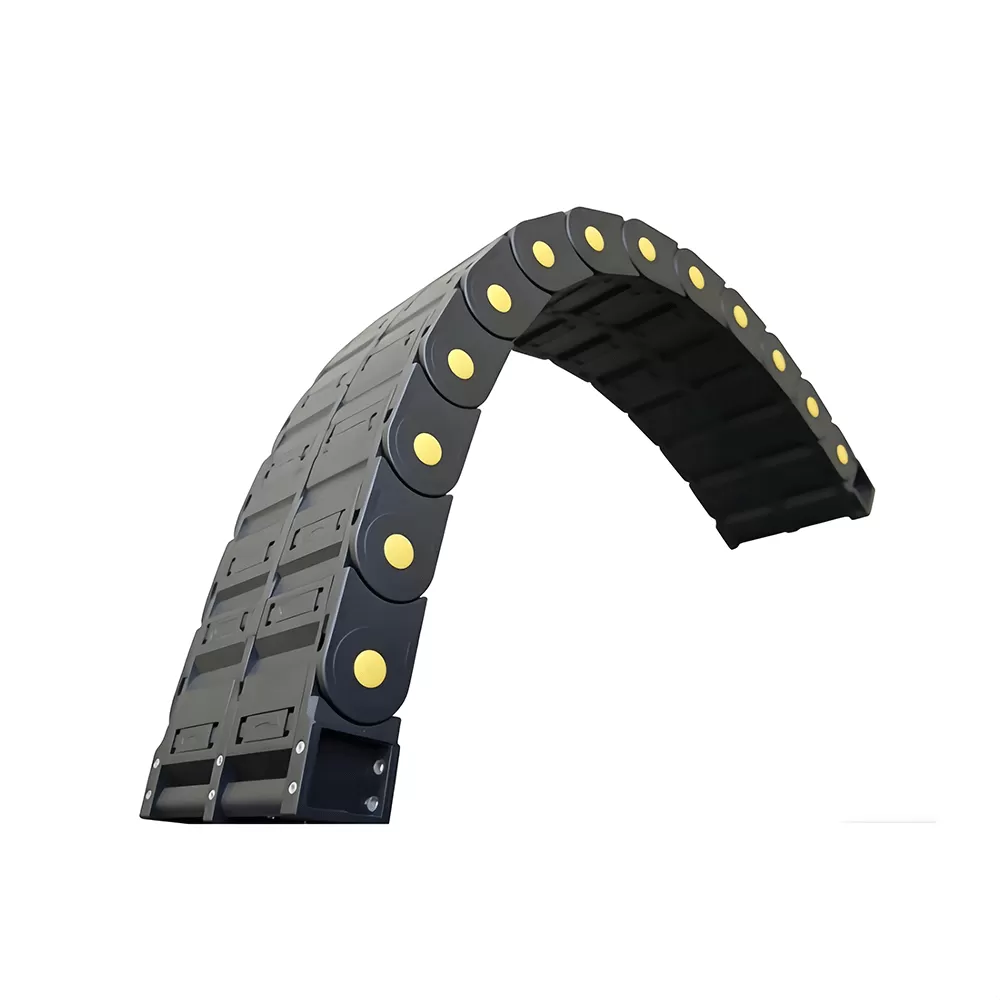
Every cable carrier has an unsupported length limit before gravity forces the upper run to sag and touch the lower run. Excessive sag increases pin wear, introduces vibration, and causes drive motor overload.
Because steel provides superior modulus of elasticity and tensile strength, a steel drag chain achieves unsupported spans exceeding 6 to 8 meters. For long travel setups reaching dozens of meters, steel tracks glide along guide troughs with predictable mechanical stability.
Top-Rated Types of Metal Cable Drag Chains
Selecting the right heavy-duty cable chain requires balancing mechanical strength, weight, environmental exposure, and budget. Three primary configurations dominate industrial automation.
1. Galvanized Steel Drag Chains
Galvanized steel serves as the reliable workhorse for standard heavy machinery. Manufacturers form the side links from high-strength carbon steel and coat them with protective zinc plating.
- Best applications: Heavy-duty gantry milling centers, large woodworking routers, paper processing machinery, and steel coil slitters.
- Advantages: Exceptional tensile strength, cost-effective heavy load support, and solid resistance to standard mechanical wear.
- Considerations: While resistant to dry environments and light oil exposure, zinc plating wears off in acidic, caustic, or marine environments.
2. Stainless Steel Cable Carriers (AISI 304 & 316)
For applications where rust, acid, or stringent hygiene standards exist, stainless steel is mandatory. Grade 304 offers solid corrosion resistance, while Grade 316 includes molybdenum for superior defense against chlorides and harsh chemicals.
- Best applications: Chemical processing lines, food and beverage processing, pharmaceutical packaging, marine cranes, and offshore oil systems.
- Advantages: Impervious to salt spray, caustic washdowns, and high acid concentrations. Retains structural integrity across deep cryogenic and high-heat environments.
- Considerations: Higher initial investment and heavier curb weight than carbon steel variants.
3. Open Frame vs. Enclosed Tube Metal Chains
The external structure of your chain determines how effectively it protects your internal lines from shop floor contaminants.
- Open Frame with Aluminum Stays: Features individual aluminum crossbars drilled or slotted to house cables. This build delivers superior heat dissipation and simple visual inspection. It minimizes overall dead weight, making it ideal for high-speed CNC axes with dry chips.
- Fully Enclosed Metal Tubes: Features interlocking metal covers that wrap the interior cavity completely. This fully enclosed design blocks heavy volumes of hot metal swarf, high-velocity grinding grit, and welding spatter from entering the track cavity.
Key Selection Criteria: How to Size Your Metal Drag Chain
Choosing an industrial drag chain based solely on visual match often leads to premature failures. System designers at QUNHUI recommend evaluating five core technical parameters before ordering hardware.
Cable Outer Diameter & Inner Height Calculation
Never pack cables tightly inside a carrier. Conduits must slide, shift, and flex without rubbing internal crossbars or binding together during operation.
Determine the diameter of your thickest cable or hose ($D_{max}$). The chain's internal height ($H_i$) should satisfy this rule:
$H_i \ge D_{max} + (0.10 \text{ to } 0.20 \times D_{max})$
Leave at least 10% to 20% safety clearance around all cables. For pressurized hydraulic hoses that expand under load, reserve up to 30% margin.
Bend Radius (R) Selection
Selecting an incorrect bend radius rapidly destroys internal electrical lines through metal fatigue or core breakage. Always consult cable manufacturer specifications for minimum dynamic bending radius ($R_{min}$).
- Standard flexible PVC control lines: $R \ge 7.5 \times \text{Cable Outer Diameter}$
- High-flex PUR servo motor cables: $R \ge 10 \times \text{Cable Outer Diameter}$
- Rigid hydraulic/pneumatic hoses: $R \ge 12 \times \text{to } 15 \times \text{Hose Outer Diameter}$
Always select a chain bend radius ($R$) matching or exceeding the largest minimum bend radius required by any single conduit in the bundle.
Stroke Length and Operating Speed
Measure the total distance the moving axis travels. The required chain length ($L_k$) for a central power feed point calculates simply:
$L_k = \frac{S}{2} + K$
Where $S$ equals total stroke length, and $K$ represents a constant derived from the carrier's bend radius plus link pitch ($\pi \times R + 2 \times \text{Pitch}$). If travel exceeds the self-supporting limit, incorporate glide shoes, support rollers, or guide channels to stabilize the run.
Internal Separators and Cable Distribution
Cables of vastly different diameters must never lie loose across one another inside the chamber. Cross-overs cause jackets to grind down, resulting in short circuits.
Use vertical dividers to isolate individual lines. Place heavy hydraulic conduits symmetrically toward the outer side plates to balance weight across the link pins. Secure electrical conductors within center compartments, separated by vertical aluminum dividers.
| Carrier Material | Max Operating Temp | Load Rating | Corrosion Resistance | Typical Use Case |
|---|---|---|---|---|
| Galvanized Carbon Steel | Up to 250°C | Extremely High | Moderate (Zinc Barrier) | Large CNC, Steel Mills, Foundries |
| Stainless Steel (304) | Up to 400°C | High | High (Chemicals, Water) | Food Automation, Clean Rooms |
| Stainless Steel (316) | Up to 500°C | High | Maximum (Acids, Marine) | Chemical Plants, Offshore Drilling |
Heavy-Duty Applications in Industrial Automation
Engineers deploy a metal cable drag chain wherever equipment operates in severe settings that chew through alternative components.
Large Gantry CNC Machining Centers
Multi-axis gantry mills generate dense showers of hot steel, iron, and aluminum chips during heavy stock removal. A heavy-duty enclosed cable track for CNC prevents razor-sharp chips from cutting into multi-core encoder lines and high-voltage spindle leads.
Steel Mills and Foundry Equipment
Casting cars, ladle transfer cars, and rolling tables experience direct thermal radiation and falling slag. Heavy-duty steel cable carriers operate continuously in these areas without softening, link distortion, or mechanical failure.
Automated Storage and Retrieval Systems (AS/RS)
Heavy warehouse stacker cranes carry substantial payloads at travel lengths often exceeding 80 meters. Metal chains maintain structural tracking over these spans, preventing snagging hazards during high-acceleration travel cycles.
Automated Welding Lines and Robotic Positioners
Robotic spot welding and submerged arc welding stations subject surrounding cables to relentless heat spatter and weld berries. Enclosed metal carriers block this molten spatter, keeping essential robot power lines intact.
Installation and Preventive Maintenance Best Practices
Even premium equipment wears out if installed improperly. Follow these practical shop guidelines to maximize service life.
- Mount Connections True and Square: Misaligned fixed or moving mounting brackets place severe torsional strain on link hinge pins. Always verify parallel alignment with dial indicators before running the axis.
- Maintain Strain Relief: Clamp every conduit securely at both the fixed base and moving towing end. Never allow internal cables to pull directly on the chain links or crossbars during movement.
- Ensure Free Cable Float: Cables should move freely within their individual partitioned compartments. Verify that each line has room to flex through the curve without binding against dividers.
- Perform Routine Pin Inspections: Inspect hinge pins and retaining rings every 1,500 run hours. Check for link wear, clear out abrasive grime accumulation, and lubricate pivot points where specified by plant standards.
Frequently Asked Questions (FAQ)
Q1: How do I calculate the bend radius of a metal cable drag
chain?
A1: First, check the datasheets for all
cables and hoses running inside the carrier. Identify the minimum dynamic bend
radius ($R_{min}$) specified by each conduit manufacturer. Find the largest
single $R_{min}$ requirement among your cables, and choose a chain bend radius
($R$) equal to or larger than that figure. Selecting a chain radius smaller than
your stiffest conduit will cause cable failure.
Q2: Can metal drag chains run at high speeds in automated
lines?
A2: Yes, though they generate more inertia
than plastic options. Galvanized steel and stainless steel carriers operate
smoothly at speeds up to 1.5 to 2 meters per second ($m/s$). If your machine
cycle requires ultra-high travel speeds exceeding 4 $m/s$, run a hybrid assembly
using lightweight aluminum stays or talk with our team about optimizing carrier
weight.
Q3: What is the typical operational lifespan of a stainless steel
cable carrier?
A3: When sized correctly and aligned
precisely, a stainless steel cable carrier can run continuously for 5 to 10
years, often outlasting the primary machine axis. Operational life depends on
total cycle count, proper distribution of internal weight, ambient chemical
concentrations, and prompt replacement of worn pivot hardware.
Q4: When should I choose an enclosed metal drag chain over an open
design?
A4: Choose an enclosed design whenever hot
cutting chips, heavy metal shavings, abrasive grinding dust, or molten welding
slag hit the track. Choose an open frame with aluminum crossbars when you need
simple cable access, clean ambient environments, and maximum heat dissipation
for power cables.
Q5: How do I choose between 304 and 316 stainless steel for
aggressive environments?
A5: Grade 304 works well
for general washdown cycles, moisture, food contact, and diluted chemicals.
Choose Grade 316 if your line encounters chlorides, salt spray, marine air,
sulfuric acid, or aggressive cleaning chemicals. Grade 316 contains 2% to 3%
molybdenum, which prevents pitting and link corrosion.
Choose QUNHUI for Reliable Cable Protection
Unplanned machine downtime damages manufacturing efficiency. Protecting high-voltage cables, sensory networks, and high-pressure fluid lines requires tough, dependable hardware built for harsh operating conditions. Choosing a top-rated metal cable drag chain keeps your plant running smoothly, eliminates line failures, and safeguards expensive equipment.
At QUNHUI, we manufacture high-performance industrial drag chain solutions for heavy-duty automation, CNC machinery, and high-heat production facilities worldwide. Whether you need standard galvanized steel tracks, custom-machined aluminum stays, or 316 stainless steel cable carriers, our engineering team will build hardware tailored to your machine footprint.
Need to upgrade your cable management? Contact the QUNHUI engineering team today to share your machine stroke, travel speed, and cable bundles. We will deliver complete engineering CAD models, sizing verification, and a competitive price quote for your next build.