
.webp)
In high-precision manufacturing, chip management is a key factor that determines the efficiency of a production line. Turning operations generate diverse waste materials, ranging from continuous stringy nests to fine powdery particulates. Without a system to evacuate this scrap, heat buildup, surface finish degradation, and tool breakage become frequent issues. Implementing a reliable cnc lathe chip conveyor is a primary step to ensure continuous operation and maintain the dimensional accuracy of machined components.
For operations utilizing automated turning centers, manual chip removal is not practical. High-speed machining parameters generate volume at a rate that can quickly overwhelm a machine tool's internal enclosure. This article analyzes the mechanical principles of various chip removal systems, identifies how different material properties dictate conveyor selection, and outlines how QUNHUI designs solutions to address common industrial chip management challenges.
.webp?t=1783676674059 "刮板式排屑机-(2)")
The Role of Automated Chip Removal in Modern Turning Operations
During the turning process, the continuous interaction between the cutting tool and the workpiece generates considerable thermal energy. A significant portion of this heat is carried away by the chips. If these chips remain inside the machining envelope, they can re-enter the cutting zone, leading to chip recutting. This recutting degrades the surface finish of the component and accelerates tool edge wear.
By integrating a dedicated cnc lathe chip conveyor, manufacturers can establish a controlled flow of scrap away from the work zone. This mechanical separation achieves several operational objectives:
Thermal Protection: Rapid removal of hot metal chips prevents heat from transferring to the lathe bed and casting structure, which helps control thermal expansion and maintain machining tolerances.
Coolant Recovery: Modern conveyor systems are designed to allow cutting fluid to drain back into the primary reservoir, reducing coolant drag-out and lowering chemical replenishment costs.
Personnel Safety: Automated evacuation minimizes the need for operators to manually clear sharp metal nests from the machine enclosure, lowering the frequency of workplace injuries.
Mechanical Configurations of Chip Conveyors
No single conveyor design is suitable for every machining application. The geometry, weight, and material of the scrap dictate the mechanical approach required for dependable transport. Selecting an incompatible system often results in motor overloads, conveyor jams, and premature wear on the belt components.
Hinged Belt Conveyors
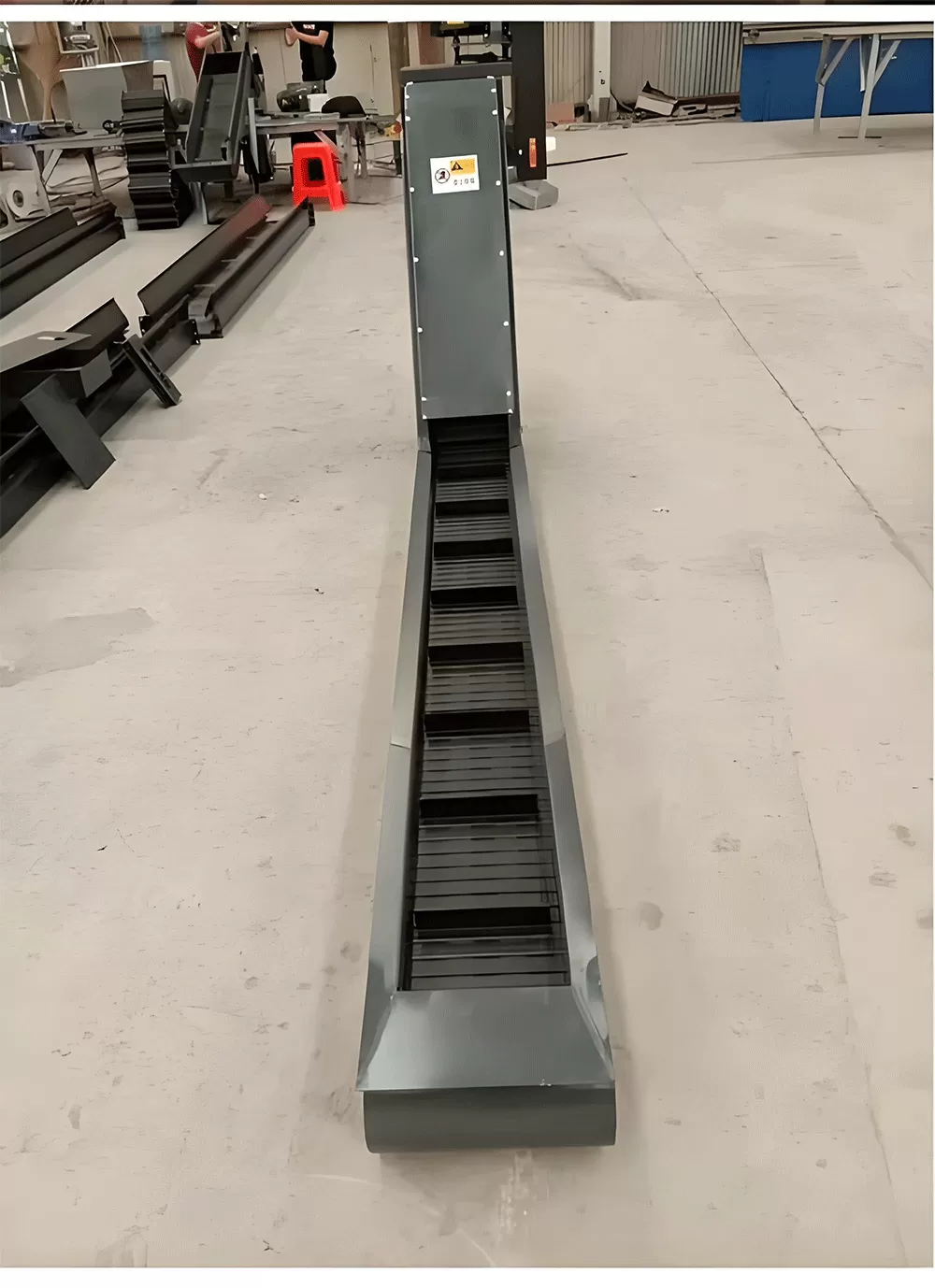
Hinged belt systems represent the most common configuration for general turning applications. These systems feature metal plates linked together to form a continuous loop. They are highly effective for handling long, curly, or bushy chips generated during the turning of carbon steels, stainless steels, and ductile irons.
The steel belt plates typically feature dimpled or textured surfaces to prevent wet chips from sticking to the conveyor bed. The conveyor incline angle must be calculated carefully; if the incline is too steep, heavy or oily chips may slide backward. Cleats are welded to the belt at regular intervals to mechanical push the scrap upward toward the discharge chute.
Scraper and Drag Conveyors
For materials that produce fine, broken chips—such as brass, bronze, cast iron, and certain aluminum alloys—hinged belts can allow fine particles to pass through the gaps between the plates. These fine particles accumulate in the coolant tank, clogging pumps and lines. A scraper conveyor, also known as a drag conveyor, solves this issue.
In this design, a series of scraping flights are attached to dual drive chains. These flights drag along the bottom of the conveyor frame, scraping the settled fine chips up the incline. The coolant remains relatively clean, and the continuous scraping action prevents the accumulation of dense sludge beds at the bottom of the machine reservoir.
Magnetic Conveyors
Magnetic evacuation systems are specialized for ferrous metalworking operations that generate small, highly abrasive particles, such as those found in cast iron machining or thread-rolling processes. Instead of an exposed moving belt, a magnetic conveyor utilizes powerful ceramic or neodymium magnets rotating beneath a sealed, stationary stainless steel faceplate.
Because there are no external moving parts to catch or jam, mechanical wear is minimal. Fine iron particles are attracted to the plate and carried along by the moving magnets underneath until they reach the discharge zone, where the magnetic field terminates, allowing the chips to fall into the collection bin.
Matching Conveyor Types to Material Characteristics
To choose the correct cnc lathe chip conveyor, a thorough assessment of the material being machined is required. The physical properties of the metal determine the shape of the chip and how it behaves under mechanical transport.
| Material Group | Chip Geometry | Recommended Conveyor Type | Key Engineering Focus |
|---|---|---|---|
| Carbon & Stainless Steel | Long, stringy, nesting | Hinged Steel Belt | Cleat height, belt pitch, and jam prevention mechanisms |
| Cast Iron | Fine, powdery, abrasive | Magnetic or Scraper | Sealed bearings, hard-wearing plate materials |
| Aluminum & Brass | Short, curly, high volume | Scraper with filtration | High coolant volume management and fine mesh separation |
When working with mixed materials on a single lathe, a hybrid conveyor design may be necessary. These systems combine a primary hinged belt to handle bulk scrap with an integrated secondary filtration drum or scraper system to capture fines. QUNHUI engineers custom configurations to accommodate these multi-material environments, ensuring that the conveyor matches the exact operational parameters of the machine tool.
Engineering Challenges in Coolant and Chip Separation
In high-pressure coolant applications, the volume of fluid flowing into the conveyor system can easily exceed several hundred liters per minute. The primary challenge is separating this liquid from the solid metal waste before the fluid is pumped back to the high-pressure nozzles.
If the chip conveyor does not incorporate adequate filtration, fine particles will cycle back through the high-pressure pump. These abrasive particles act as cutting agents under high pressure, causing rapid erosion of the pump seals, internal valves, and the cutting tool itself. To mitigate this, advanced chip management systems feature integrated settlement chambers and self-cleaning rotary filters. The fluid passes through a wedge-wire or mesh screen while the scraper mechanism continuously removes the filtered solids, preserving the integrity of the coolant system.
Preventative Maintenance and Wear Mitigation
The environment inside a cnc lathe chip conveyor is harsh. Continuous contact with abrasive metals, corrosive cutting fluids, and heavy mechanical loads leads to wear over time. Implementing a structured maintenance program is necessary to prevent unplanned downtime.
Chain Tension Adjustment: Drive chains stretch slightly during their initial break-in period. Regular tension checks prevent chain slack, which can cause the belt to skip teeth on the drive sprockets or track unevenly.
Lubrication of Drive Components: While the internal parts of the conveyor are often bathed in coolant, external drive chains and motor gearboxes require dedicated lubrication to prevent friction-induced wear and corrosion.
Enclosure Inspection: Wiper seals and side guards must be inspected periodically. Worn seals allow fine chips to enter the internal frame of the conveyor, where they can accumulate and bind the return path of the belt.
By utilizing hardened steel alloys on wear-prone tracks and incorporating torque-limiting clutches on the drive motors, QUNHUI designs systems that minimize these maintenance overheads, offering prolonged service life even in continuous three-shift production environments.
Frequently Asked Questions
Q1: How do I determine the correct belt pitch for my conveyor application?
A1: Belt pitch is determined by the volume and size of the chips, as well as the space constraints within the lathe's casting. A smaller pitch (e.g., 31.75 mm) is suitable for compact lathes and light-to-medium chip volumes. A larger pitch (e.g., 50.8 mm or 101.6 mm) is selected for heavy-duty turning centers handling high-volume steel scrap or large forged components.
Q2: Can an aluminum chip conveyor be used for magnetic materials?
A2: While a scraper conveyor designed for aluminum can physically move magnetic steel chips, the reverse is not true. A magnetic conveyor cannot move aluminum chips because aluminum is non-ferrous and will not respond to the magnetic field. For facilities processing both materials, a mechanical hinged belt or scraper conveyor is the appropriate choice.
Q3: Why does my conveyor suffer from frequent jamming when machining stainless steel?
A3: Stainless steel is prone to work hardening and often forms long, tough, continuous strings rather than segmented chips. These stringy nests can catch on the conveyor frame or wrap around the drive sprockets. To prevent this, consider upgrading to a conveyor with serrated cleats, integrated chip cutters, or reducing the lathe feed rate to encourage chip breaking.
Q4: What is the benefit of a variable speed drive on a chip conveyor?
A4: A variable speed drive allows operators to match the conveyor speed to the chip generation rate. Running a conveyor too fast increases mechanical wear on the belt and tracks unnecessarily. Running it too slow can cause chips to accumulate in the hopper, leading to potential blockages. Matching the speed to the process optimizes both energy efficiency and component life.
Q5: How does coolant temperature affect conveyor operation?
A5: Extremely hot chips can raise local coolant temperatures, which may cause thermal expansion of the conveyor belt plates. This expansion can cause tracking issues if clearances are too tight. High-quality conveyor designs incorporate expansion allowances and use heat-resistant materials for seals and rollers to ensure stability under varying thermal conditions.
Collaborate with QUNHUI for Tailored Chip Management
To maximize the productivity of your CNC turning operations, selecting a generic conveyor is often insufficient. Each machine tool configuration, material mix, and facility layout presents unique demands. QUNHUI specializes in the design, engineering, and manufacturing of custom chip evacuation systems tailored to specific industrial environments.
Whether you are replacing an existing unit, integrating automation into a production line, or configuring a new machining cell, our engineering team can provide detailed CAD drawings and technical specifications to match your exact requirements. We invite you to contact us with your project parameters, material types, and space constraints. Our team will review your data and submit a comprehensive technical proposal designed to keep your production moving efficiently.
Please send your detailed project specifications and inquiry to our sales engineering department to discuss your custom solution.