

The reliable transmission of power, data, and fluid media in heavy-duty CNC machining centers and automated production lines depends fundamentally on the mechanical integrity of cable guidance systems. Among these, the high tensile drag chain occupies a critical position, engineered to withstand extreme cyclic loads, abrasive environments, and continuous high-speed operation. Unlike standard energy chains, high tensile variants are designed with augmented link geometry, advanced alloy metallurgy, and precision pin connections that collectively deliver superior fatigue resistance and load-bearing capacity. For engineering teams specifying motion control components, understanding the interplay between material science, tribology, and dynamic stress analysis is essential for achieving optimal service life and process reliability.
The operational demands placed on drag chains in modern manufacturing—particularly in gantry-style machining centers, robotic transfer systems, and heavy-load pallet conveyors—require a departure from generic selection criteria. A high tensile drag chain must accommodate not only the cumulative weight of bundled cables and hoses but also the inertial forces generated during rapid acceleration and deceleration cycles. This article systematically addresses the technical dimensions that define high-performance drag chain engineering, from metallurgical composition to predictive maintenance strategies, providing a framework for informed specification in mission-critical automation projects.
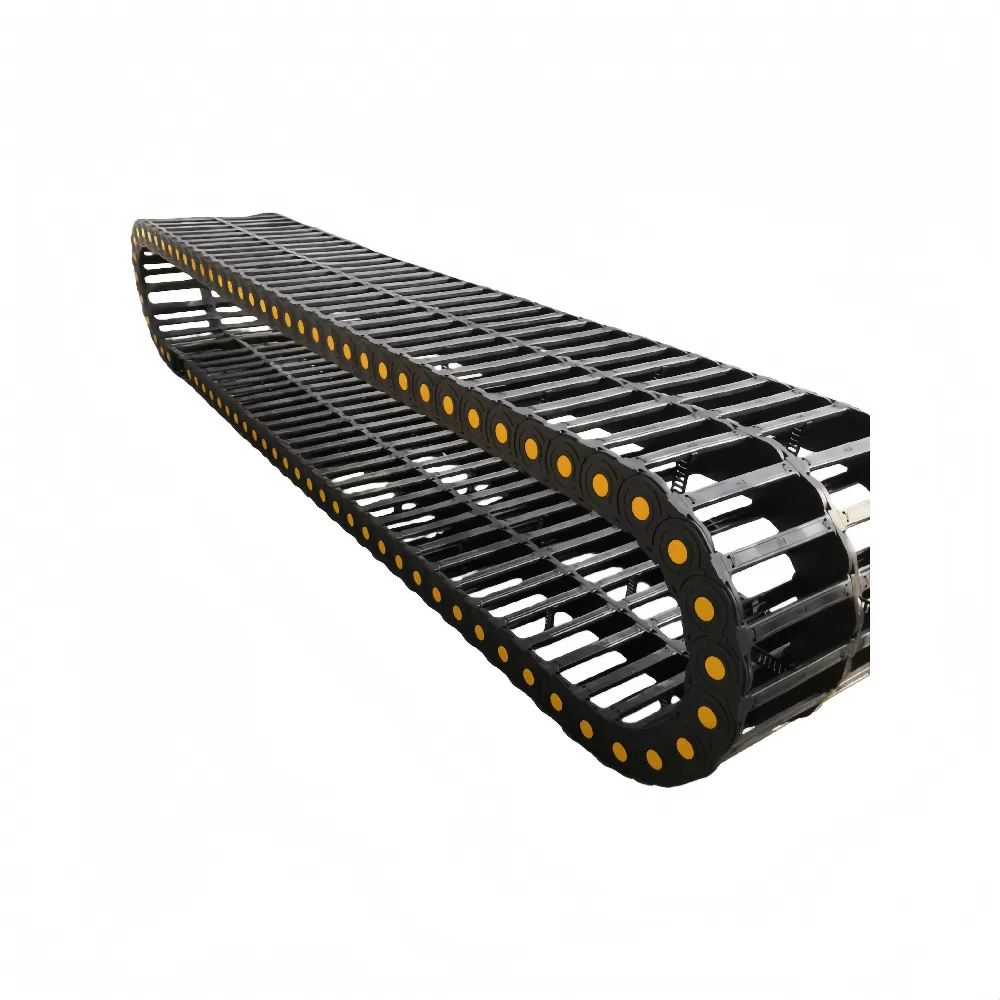
Metallurgical and Design Fundamentals of High Tensile Drag Chain
The foundational performance attributes of a high tensile drag chain originate in its material selection and link architecture. Manufacturers typically employ medium-carbon alloy steels such as 42CrMo4, which after quenching and tempering achieves a tensile strength exceeding 1200 MPa combined with adequate ductility for impact absorption. For corrosive environments, precipitation-hardening stainless steels like 17-4PH offer comparable strength with superior pitting resistance. The link cross-section is optimized through finite element analysis to distribute stress evenly across the side bars, minimizing localized strain concentrations that could initiate fatigue cracks. Pin connections represent a critical interface; hardened steel pins with ground finishes and interference-fit assemblies ensure consistent articulation while reducing wear particle generation. Surface treatments—including induction hardening of pin bores and phosphate coating for corrosion protection—further extend the operational envelope. Companies like QUNHUI have refined these design parameters through extensive test-bench validation, correlating finite element predictions with empirical fatigue data to establish reliable performance benchmarks.
Beyond material properties, the geometric configuration of the high tensile drag chain directly influences its load-handling capability. Key design elements include:
Link pitch – determines the bending radius and articulation smoothness; a smaller pitch allows tighter curves but increases the number of joints.
Side-bar thickness – directly contributes to the cross-sectional area resisting tensile stress; thicker bars increase load capacity but add mass.
Pin diameter – influences shear strength and wear resistance; larger pins distribute load more evenly across the bushing surfaces.
Safety factor – typically 4:1 relative to the ultimate tensile strength, accounting for dynamic amplification and unforeseen shock loads.
Industry standards such as DIN 32876 provide guidelines for calculating the permissible tensile force based on chain width and pin shear area. In practice, designers must also account for dynamic amplification factors, as shock loads during emergency stops can multiply static tension by a factor of three or more. This underscores the importance of selecting a chain with adequate reserve strength, a consideration that becomes particularly acute in high-acceleration pick-and-place applications.
Application-Specific Load Profiling for High Tensile Drag Chain Systems
Effective specification of a high tensile drag chain begins with a rigorous characterization of the application's load profile. This involves quantifying the total mass of cables and hoses per meter, the bending radius constraints of the bundled media, and the travel length and speed parameters of the moving carriage. In CNC machining centers, the drag chain often follows a complex 3D path, requiring articulation in multiple planes simultaneously. The tensile load on the chain comprises the weight of the hanging loop, the friction between links, and the drag force exerted by the cable bundle's resistance to bending. For long travel lengths exceeding 30 meters, the cumulative weight alone can impose substantial tensile stresses, necessitating the use of high tensile drag chain configurations with reinforced side bars and oversized pins.
Another critical factor is the operating speed and acceleration profile. Modern high-speed machining centers achieve traverse rates of 60 m/min or higher, with accelerations up to 1.5 g. Under these conditions, the inertia of the moving chain and cable bundle generates dynamic tensile forces that can exceed static loads by a significant margin. Engineering teams must therefore calculate the equivalent dynamic load and compare it against the chain's dynamic load rating, which is typically derived from accelerated life testing at defined stroke lengths and cycle rates. The high tensile drag chain selected for such applications should demonstrate a proven track record in similar speed regimes, with documented fatigue performance under representative duty cycles.
Fatigue Resistance and Service Life Prediction in Cyclic Operations
Fatigue failure represents the predominant end-of-life mechanism for drag chains in continuous production environments. Each bending cycle induces alternating tensile and compressive stresses in the link side bars, progressively accumulating damage that eventually manifests as crack initiation and propagation. The high tensile drag chain addresses this challenge through design features that mitigate stress concentration factors, including generous fillet radii at link corners and precision-ground pin holes that eliminate surface irregularities. The fatigue strength of the base material, typically around 600 MPa at 107 cycles for quenched-and-tempered alloy steel, provides a starting point for life estimation. However, the actual fatigue performance is influenced by factors such as:
Surface finish and residual stress state from manufacturing processes.
Presence of notch effects at weld joints or heat-affected zones.
Operating temperature, which reduces fatigue strength at elevated levels.
Corrosion or pitting that creates stress raisers on the link surface.
Service life prediction for a high tensile drag chain commonly employs the Palmgren-Miner linear damage accumulation rule, which combines the stress amplitudes from different operating segments to estimate total fatigue damage. In practice, manufacturers provide life curves correlating load magnitude with expected cycle count, enabling engineers to select a chain that delivers the required durability for the application's design life. For instance, a chain rated for 10 million cycles at 80% of its ultimate tensile strength may be derated to 5 million cycles if the operating temperature exceeds 80°C, reflecting the temperature-dependent reduction in fatigue resistance. This relationship underscores the need for a holistic approach that considers both mechanical and thermal factors in service life assessment.
Environmental Degradation Factors Affecting High Tensile Drag Chain Performance
The operating environment exerts a profound influence on the longevity and reliability of a high tensile drag chain. In metalworking facilities, airborne particulates—including grinding dust, metal chips, and coolant mist—can infiltrate pin joints, accelerating abrasive wear and increasing articulation torque. The presence of aggressive cutting fluids, particularly those containing chlorinated or sulfurized additives, may attack the protective oxide layer on steel surfaces, promoting pitting corrosion and stress corrosion cracking. Elevated temperatures, common near spindles and casting furnaces, accelerate the oxidation rate and reduce the yield strength of the chain material. The high tensile drag chain must therefore be specified with appropriate surface protection, such as zinc-nickel plating or Dacromet coating, to withstand these aggressive conditions while maintaining dimensional stability and articulation smoothness.
Humidity and condensation pose additional risks, especially in facilities without climate-controlled enclosures. Moisture ingress into pin-bushing interfaces can lead to fretting corrosion, where microscopic relative motion between contacting surfaces generates wear debris and accelerates material removal. Regular inspection intervals should include checks for corrosion products, which appear as reddish-brown deposits around pin ends and link seams. For applications in food-processing or pharmaceutical environments, where wash-down protocols involve caustic cleaning agents, the high tensile drag chain may require a fully stainless-steel construction with sealed pins and food-grade lubricants. These environmental considerations directly influence the total cost of ownership and must be factored into the initial procurement decision.
Installation Tensioning and Maintenance Protocols
Proper installation tensioning is paramount to achieving the designed service life of a high tensile drag chain. Excessive pretension increases the baseline stress on the chain, reducing its fatigue margin and accelerating wear on pin joints. Insufficient tension, conversely, allows the chain to sag between supports, leading to snagging, vibration, and uneven load distribution across the links. The optimal tensioning approach involves measuring the chain's catenary sag under static load and adjusting the take-up mechanism until the sag equals 1-2% of the span length for horizontal installations. For vertical or inclined runs, a slightly higher tension is recommended to prevent the chain from buckling under its own weight. QUNHUI provides detailed installation guidelines that specify torque values for clamping bolts and acceptable deflection ranges, ensuring that field adjustments achieve the intended preload condition.
Maintenance protocols for the high tensile drag chain encompass both lubrication and condition monitoring. The pin-bushing interfaces require periodic replenishment of solid-film lubricants, typically molybdenum disulfide or graphite-based compounds, applied at intervals defined by the manufacturer based on operating hours and cycle count. Over-lubrication must be avoided, as excess grease can attract contaminants and form abrasive pastes. Condition monitoring relies on measurable parameters such as:
Chain elongation – expressed as a percentage increase over the nominal pitch; when elongation exceeds 2-3%, the chain should be replaced to prevent pinion misalignment and accelerated cable wear.
Pin wear – measured by dimensional checks or by observing play between links.
Link deformation – visual inspection for cracked links or bent side bars.
Regular measurements with a calibrated tension gauge and visual inspections for cracked links or deformed side bars form the basis of a sound maintenance strategy.
Integration with Smart Monitoring Systems
The advent of Industry 4.0 has introduced smart monitoring capabilities that enhance the operational visibility of high tensile drag chain systems. Embedded sensors, including strain gauges and accelerometers, can provide real-time data on tensile load, vibration amplitude, and articulation temperature. This data, transmitted to a centralized condition monitoring platform, enables predictive maintenance algorithms to detect incipient faults before they escalate into catastrophic failures. For instance, a gradual increase in peak tensile load over successive cycles may indicate the onset of cable bundle binding or the accumulation of foreign matter within the chain track. Similarly, elevated vibration signatures at specific frequencies can point to worn pin joints or misaligned guide rails. Integrating these sensor streams with the machine's control system allows for automated adjustments to acceleration profiles or the scheduling of maintenance interventions during planned downtimes.
Advanced monitoring systems also facilitate the correlation of chain performance with process parameters, such as spindle speed, feed rate, and coolant flow. By analyzing this multivariate data, engineering teams can identify operating conditions that impose excessive stress on the high tensile drag chain and implement corrective measures, such as reducing rapid traverse speeds in non-cutting movements or optimizing acceleration/deceleration ramps. This closed-loop approach not only extends the service life of the drag chain but also contributes to overall machine reliability and product quality. QUNHUI offers integrated monitoring solutions that are compatible with common industrial communication protocols, allowing seamless integration into existing IIoT infrastructures.
Comparative Analysis of High Tensile Drag Chain Materials
The selection of an appropriate material for a high tensile drag chain requires a comparative evaluation of mechanical properties, corrosion resistance, and cost. Alloy steel grades such as 42CrMo4 and 34CrNiMo6 offer the highest tensile strength and fatigue resistance, making them suitable for heavy-load, high-cycle applications in dry or mildly corrosive environments. Their primary limitation is susceptibility to rust, necessitating protective coatings or regular lubrication. Stainless steel alternatives, including 17-4PH and AISI 316L, provide superior corrosion resistance at the expense of slightly lower yield strength and higher material cost. For applications involving frequent wash-downs or exposure to aggressive chemicals, the stainless steel option becomes economically justified when considering the reduced maintenance frequency and longer replacement intervals.
In specialized applications where weight reduction is critical, such as in aerospace or mobile automation systems, aluminum alloys with hard-anodized coatings may be considered. While their tensile strength is significantly lower than steel-based alternatives, modern alloy compositions like 7075-T6 can achieve acceptable performance in moderate-load scenarios. The comparative analysis should also consider the availability of compatible accessories, including mounting brackets, guide rails, and separators, as these components must match the chain's material and dimensional specifications. Engineering teams should consult material data sheets that provide comprehensive property tables, including elastic modulus, thermal expansion coefficient, and electrical conductivity, to ensure a holistic evaluation that aligns with the application's functional requirements.
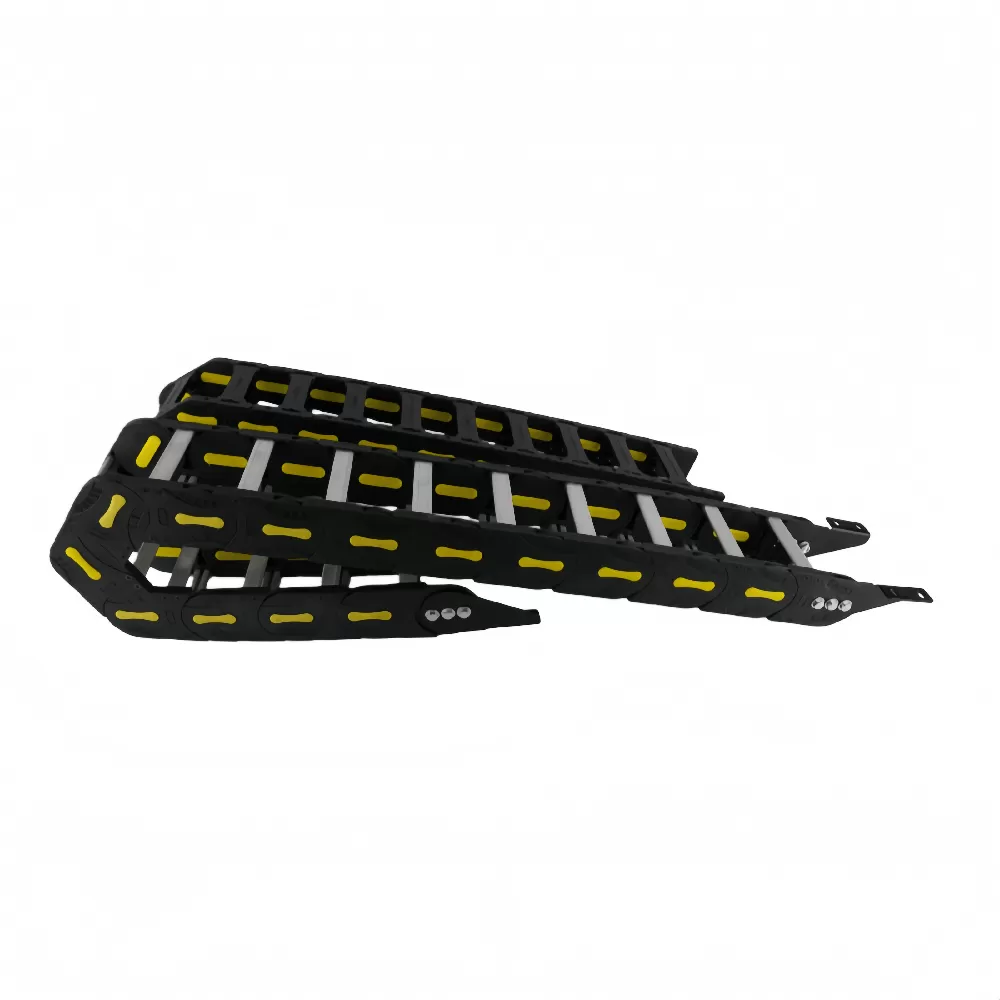
Cost-Benefit Considerations in High Tensile Drag Chain Specification
The economic case for selecting a high-grade high tensile drag chain is grounded in a total-cost-of-ownership (TCO) analysis that extends beyond the initial procurement price. Factors contributing to TCO include installation labor, scheduled maintenance, spare parts inventory, downtime costs during replacement, and the risk of unplanned failures that disrupt production. A premium chain manufactured to stringent tolerances and subjected to rigorous quality control typically commands a higher price but delivers extended service life and reduced failure rates. For a production line operating 24/7 with an average uptime value of several thousand dollars per hour, the incremental cost of an upgraded high tensile drag chain is often recouped within a few months through avoided downtime and maintenance hours.
Lifecycle cost models should incorporate the anticipated replacement interval, the cost of lubricants and consumables, and the labor required for periodic inspections and tension adjustments. In high-duty-cycle applications, a high tensile drag chain that achieves 15 million cycles versus a standard chain's 5 million cycles effectively triples the replacement interval, delivering substantial savings in parts procurement and installation labor. QUNHUI provides TCO calculators that allow engineers to compare different chain grades based on their specific application parameters, facilitating data-driven procurement decisions that balance performance requirements with budgetary constraints. This analytical approach ensures that the selected chain delivers the optimal return on investment over its entire service life.
Frequently Asked Questions About High Tensile Drag Chain Engineering
What is the maximum tensile load a high tensile drag chain can withstand?
The maximum tensile load depends on the chain's design, material, and size. For a typical 42CrMo4 alloy steel chain with a 60 mm pitch and 40 mm side-bar thickness, the ultimate tensile strength can exceed 150 kN. The working load limit, however, is typically set at 20-25% of the ultimate strength to provide a safety factor of 4-5. Always consult the manufacturer's data sheet for the specific chain model, as load ratings are determined through standardized testing protocols such as ISO 15890.
How does operating temperature affect high tensile drag chain performance?
Elevated temperatures reduce the yield strength and fatigue resistance of steel alloys through softening of the tempered martensitic structure. For each 10°C increase above 20°C, the fatigue strength may decrease by approximately 2-3%. Continuous operation above 120°C requires derating of the load capacity, while temperatures exceeding 150°C may necessitate the use of heat-resistant alloys or ceramic-coated pins. Conversely, low temperatures below -10°C can make the chain material more brittle, requiring impact-resistant grades with higher nickel content.
What are the critical lubrication requirements for high tensile drag chain systems?
Lubrication serves to reduce friction between pin and bushing, minimizing wear and preventing galling. A high-quality solid-film lubricant containing molybdenum disulfide (MoS₂) or graphite is recommended, applied at intervals of 500-1000 operating hours depending on duty cycle. Grease-based lubricants with extreme-pressure additives may be used in slower-moving applications, but they must be compatible with the cable insulation materials. Over-greasing should be avoided to prevent accumulation of debris. Some high-end chains feature self-lubricating bushings with embedded PTFE, significantly extending the lubrication interval.
How does bending radius influence the selection of a high tensile drag chain?
The bending radius determines the minimum curvature the chain can accommodate without causing excessive stress on the links or damage to the internal cables. A general rule is that the bending radius should be at least 7-10 times the chain pitch for steel-based chains, and 10-15 times for reinforced polymer chains. Smaller bending radii increase the articulation angle per link, accelerating pin wear and reducing service life. When routing a high tensile drag chain around tight corners, engineers must verify that the selected chain meets the bending radius requirements of both the chain and the contained cables and hoses.
What are the signs of impending failure in a high tensile drag chain?
Key indicators include: (a) increased chain elongation beyond 2-3% of nominal pitch, (b) visible cracks or deformation in side bars or pin plates, (c) irregular or jerky movement during operation, (d) abnormal noise such as clicking or grinding during articulation, and (e) excessive wear debris accumulation around pin joints. Regular visual inspections combined with measurement of chain tension and pitch length provide early warning of degradation. Implementing a predictive maintenance program with vibration analysis can detect bearing wear before it becomes visually apparent.
How does high tensile drag chain compare to standard drag chains in CNC applications?
High tensile drag chains are specifically engineered for applications involving heavy cable bundles, long travel lengths, and high acceleration rates—conditions that exceed the capabilities of standard chains. They offer higher ultimate tensile strength, improved fatigue resistance, and enhanced wear performance through advanced materials and heat treatment. Standard chains are suitable for lighter loads and lower cycle frequencies, but in high-end CNC machining centers with traverse speeds exceeding 50 m/min, the high tensile variant becomes essential for ensuring reliable operation and avoiding premature failures that would cause costly production interruptions.
Technical Reference and Engineering Support
For detailed technical specifications, application-specific load calculations, or customized engineering support for high tensile drag chain integration, the engineering team at QUNHUI provides comprehensive design assistance. Access product datasheets, CAD models, and lifetime performance data through the technical support portal. Direct inquiries regarding material selection, installation protocols, or smart monitoring integration can be directed to the engineering department via email: qunnhui3286@gmail.com. The technical support team offers application reviews, on-site installation guidance, and failure analysis services to ensure optimal chain performance across the complete operational lifecycle.