

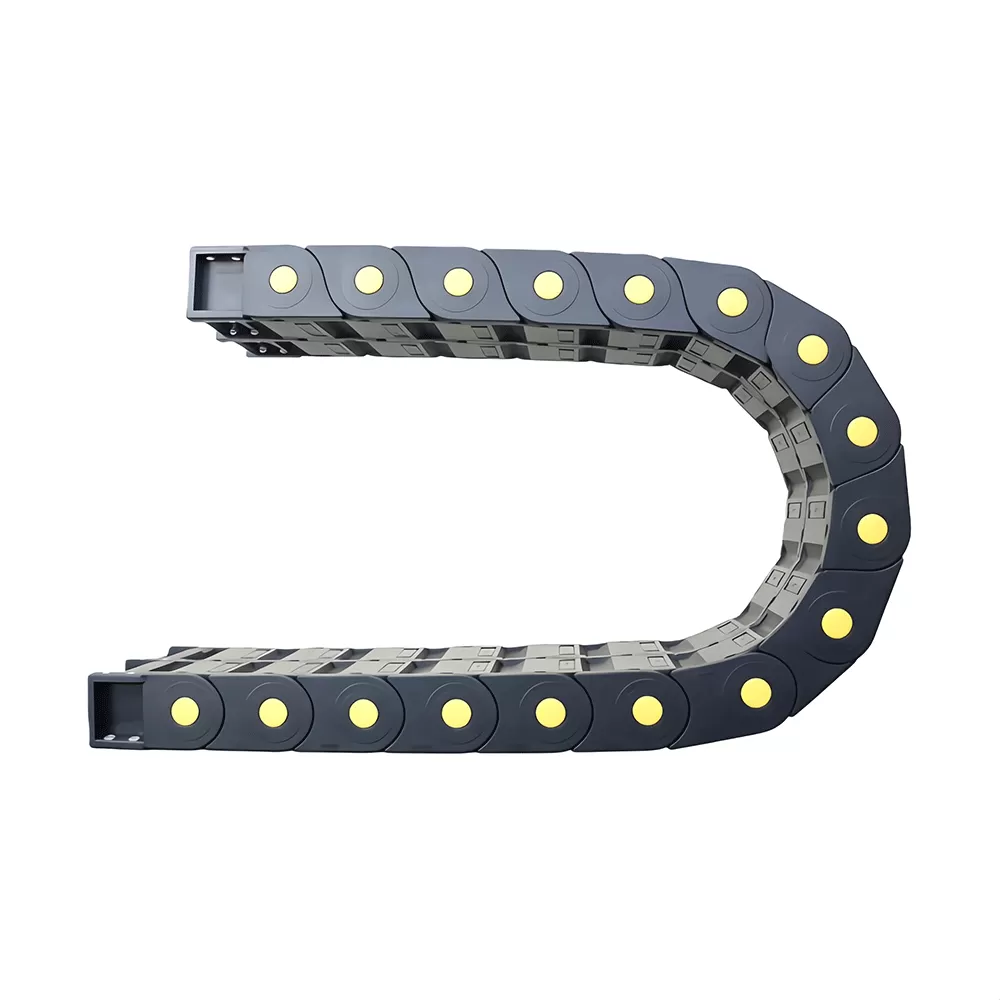
Dynamic cable management systems serve as the structural vascular system of modern industrial automation, CNC machining centers, robotics, and heavy material handling gantries. Within these high-duty-cycle environments, evaluating a drag chain price requires far more than comparing line-item catalog quotes. Procuring an industrial cable carrier—alternatively known as an energy chain, drag chain, or cable track—demands an analytical approach that correlates upfront capital expenditure with mechanical wear rates, environmental durability, and operational longevity.
Selecting the incorrect energy carrier inevitably results in localized link fractures, pin-and-bore shear failures, damaged internal conductor insulation, and catastrophic unplanned production stoppages. Specifying engineers and procurement specialists must dissect the underlying design characteristics, manufacturing processes, and continuous-flex dynamics that dictate market pricing. Analyzing these critical variables ensures that machine builders achieve an optimal balance between structural resilience and component cost.
Foundational Cost Drivers in Dynamic Cable Carrier Systems
Every commercial quote for an automated cable carrier reflects precise mechanical constraints, raw material compositions, and manufacturing complexities. Evaluating the true drag chain price requires breaking down these baseline production elements to understand why superficially identical carriers perform differently under sustained multi-axis acceleration.
Raw Material Formulations and Polymer Synthesis
The primary baseline for pricing begins at the molecular level. Standard dynamic cable chains utilize engineered thermoplastics, predominantly Polyamide 66 (PA66). Lower-tier units rely on recycled or non-reinforced polymers that lack dimensional stability under thermal fluctuation. Premium carriers employ virgin PA66 compounds modified with chemically coupled silane-treated glass fibers, typically ranging from 15% to 35% by volume.
This fiber reinforcement raises the tensile strength and flexural modulus of the material, which directly prevents structural sagging over extended travels. Specialized compounding processes introduce additives to manage specific operational hazards:
Tribological Modifiers: Micro-encapsulated solid lubricants, such as polytetrafluoroethylene (PTFE) or molybdenum disulfide, integrated directly into the polymer matrix to reduce joint pin friction, operational noise, and hinge-point particulate generation.
Halogen-Free Flame Retardants: Additives designed to meet strict flammability standards, such as UL94 V-0, essential for enclosed environments and specialized vehicle systems.
Conductive Carbon Nanotubes or Carbon Fibers: Compounds formulated to achieve consistent surface resistivity (typically 104 to 108 ohms), ensuring continuous electrostatic discharge (ESD) dissipation in semiconductor manufacturing environments.
Each additive package significantly increases the compounding expense, driving the raw material expenditure far past that of utility-grade plastic resins and directly influencing the initial drag chain price from the molding stage.
Tooling Precision, Injection Molding, and Tool Architecture
The structural integrity of each carrier link depends on injection mold design, cycle time management, and hydraulic clamping accuracy. Precision molds incorporate complex side-action slides to form undercut stop-dogs, crossbar hinge interfaces, and snap-lock cavities. High-tolerance link pins and bores demand micron-level mold precision to prevent flash formation, out-of-round pin holes, and localized sink marks.
In high-speed cycling, mold cooling channels must maintain uniform thermal dissipation across the link geometry. Uneven cooling induces internal residual stresses, which manifest as directional bowing across long chain assemblies. The production amortizations of high-cavity, hot-runner hardened tool-steel molds (such as H13 or S7 tool steels) contribute substantially to the baseline cost structure of industrial components compared to generic commodity moldings.
Mechanical Specifications That Determine Drag Chain Price
As mechanical demands scale, carrier geometry must evolve to withstand higher continuous mechanical loads. Mechanical engineers must identify the boundary limits where a standard profile carrier is no longer sufficient, requiring an upgrade to specialized, higher-cost mechanical designs.
Travel Length, Kinematics, and Mechanical Sag
Carrier mechanics fall into distinct operating profiles based on installation distance and support conditions:
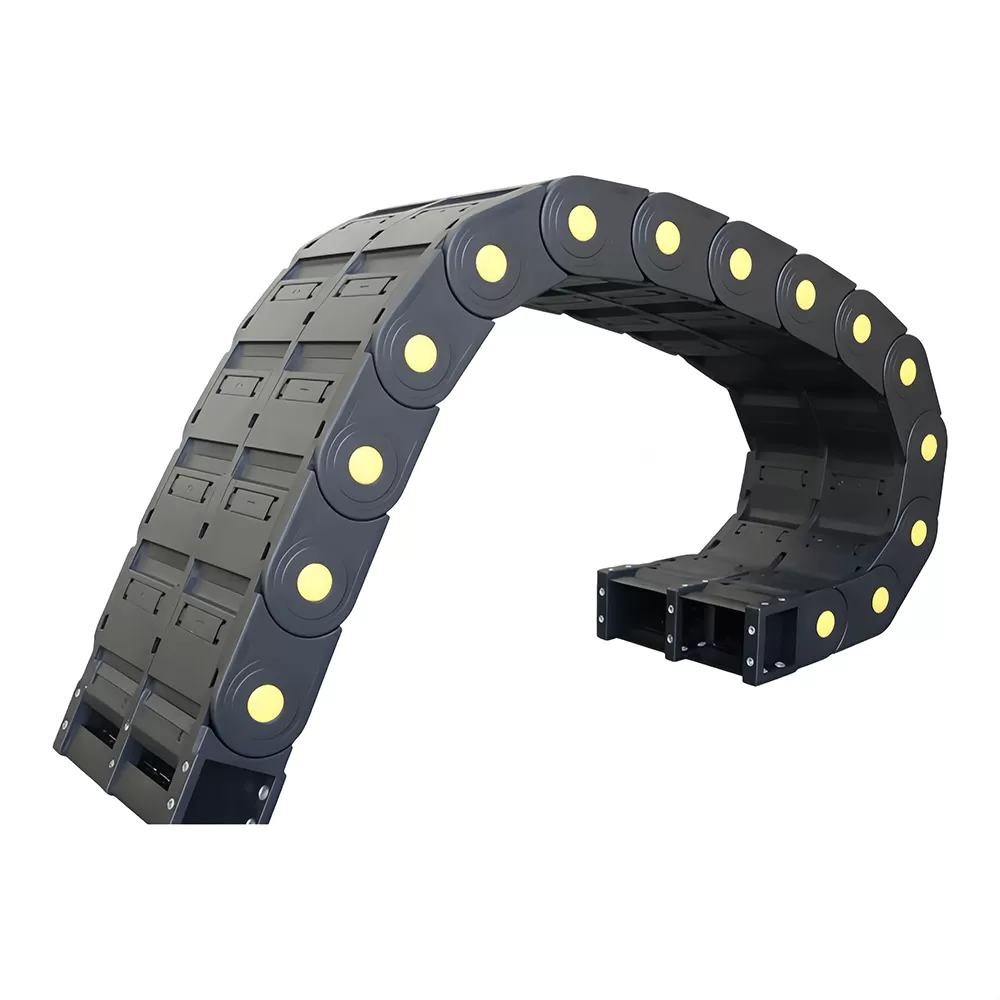
Self-Supporting Travel: The upper run of the carrier glides without contacting the lower run. Structural stop-dogs on each link absorb the cantilever moment. As unsupported length increases, the bending moment at the fixed bracket increases exponentially, necessitating massive link side plates, thicker cross-sections, and elevated material mass.
Gliding Applications: Over long travel distances (often exceeding 6 to 10 meters), the upper run directly contacts and slides over the lower run. This configuration requires integrated glide shoes or ultra-high-molecular-weight polyethylene (UHMW-PE) wear pads, along with dedicated metal guide troughs.
Dynamic Acceleration and Velocity: Accelerated profiles exceeding 50 m/s2 and speeds over 5 m/s exert immense centrifugal and inertial forces on link hinge points. Managing these forces requires dual-pin configurations, reinforced interlinking joints, and dynamic impact-dampening zones that elevate the dynamic drag chain price relative to low-velocity utility tracks.
Internal Cross-Sectional Geometry and Compartmentalization
The internal footprint of a carrier dictates link width, crossbar design, and separator arrangements. Simple open-frame chains utilize solid or snap-open crossbars on one side. Complex automation setups require openable crossbars on both the inner and outer radii to facilitate field harness assembly and maintenance.
Uncontrolled internal cable rubbing represents a primary driver of electrical core failure. Internal compartmentalization requires vertical dividers, horizontal shelving, and modular strain relief combs. Machined or molded structural separator arrays increase component part counts and assembly labor, contributing directly to the final system configuration cost.
Metallurgical Variants: Steel and Hybrid Structural Systems
Polymer chains handle a vast proportion of general automation tasks, yet heavy-duty industrial settings necessitate metal systems. Steel carriers occupy a completely distinct pricing bracket due to raw material inputs, stamping, laser-cutting, plating, and specialized machining operations.
| Material Construction | Primary Mechanical Strengths | Operating Limitations | Relative Acquisition Cost Tier |
|---|---|---|---|
| Glass-Filled Polyamide (PA66-GF) | Low inertia, chemical resistance, quiet operation, snap-together assembly | Temperature limit ~120°C, lower ultimate tensile capacity than steel | Baseline / Economic to Moderate |
| Zinc-Plated Carbon Steel | Massive structural load capacity, broad unsupported lengths, chip resistance | High operational inertia, requires lubrication, corrosion vulnerability | Intermediate to High (2.5x – 4x Polymer) |
| Stainless Steel (AISI 304 / 316) | Extreme corrosion resistance, high tensile capacity, up to 600°C limits | Heavy dynamic mass, low maximum acceleration profiles, galling tendency | Premium (5x – 9x Polymer) |
| Hybrid (Aluminum Crossbars + Polymer Links) | Customizable internal widths without new mold tooling, low mass, rigid frame | Galvanic compatibility considerations, modular joint complexity | Moderate to High (1.8x – 3x Polymer) |
Heavy metallurgical carriers find application in large-bed CNC gantry systems, steel mill scrap cranes, offshore drilling platforms, and foundries. In these spaces, burning hot slag, continuous metallic chips, and heavy hydraulic line payloads would instantly compromise plastic side plates. The extended manufacturing cycles required for laser-cutting high-gauge steel links, precision stamping, robotic pin riveting, and passivation treatments establish the higher capital tiers of these extreme-duty assemblies.
Environmental Operating Conditions and Formulation Premiums
Ambient operational environments dictate custom material alterations. Standard engineering chains installed in hostile environments degrade rapidly through mechanical hardening, chemical embrittlement, or hinge erosion.
Thermal Extremes and Chemical Resistance
Cold-storage logistics, arctic drilling machinery, and aerospace testing chambers demand specialized impact-modified polymers that retain ductility below -40°C. Standard PA66 becomes exceptionally brittle at these temperatures, leading to stop-dog fracture upon sudden dynamic acceleration. Conversely, operating environments adjacent to thermal ovens, furnaces, or glass manufacturing lines require modified high-temperature polymer matrixes that continuously maintain tensile integrity at 130°C to 160°C.
Chemical exposure further dictates engineering requirements. Plants managing aggressive coolants, hydraulic fluids, cutting oils, and alkaline washdowns require polymers that resist environmental stress cracking (ESC). Special sealing configurations, completely enclosed design geometries (tubes rather than open link designs), and fluoropolymer integration prevent coolant particulates from settling into the hinge cavities. Enclosed cable tubes shield internal dynamic assemblies completely from glowing hot cutting swarf, but the added tooling and material weight directly reflect in higher cost structures.
Cleanroom Standards and Particulate Management
Semiconductor, pharmaceutical, and flat-panel display manufacturing facilities mandate systems certified under ISO 14644-1 cleanroom classifications. Standard open drag chains generate micro-particulates through the continuous frictional contact of pins rotating inside their respective bores during link articulation.
Cleanroom-rated cable management systems resolve this issue by replacing standard pin joints with flexible, wear-free elastomeric hinge webs, or by sealing the joints within proprietary low-friction synthetic pods. Meeting ISO Class 1 cleanliness involves cleanroom manufacturing packaging, ultrasonic parts cleaning, and specialized verification documentation, resulting in a substantial premium over general shop-floor carriers.
Total Cost of Ownership: Procurement vs. Operational Performance
Experienced automation engineers recognize that the initial purchase invoice represents only a fractional percentage of an industrial machine's complete operating expenditure. Downtime across automotive assembly plants, automated container terminals, and precision laser cells frequently accumulates costs reaching thousands of dollars per minute.
Analyzing long-term value against the purchase drag chain price requires evaluating mean time between failures (MTBF) and predictive lifecycle cycles. When an undersized or sub-optimally manufactured carrier fails, the cascade of mechanical failures follows a predictable path:
The link stop-dog shears under dynamic bending stress, causing the carrier to sag beyond acceptable clearances.
The sagging carrier catches on a frame protrusion, structural member, or pneumatic drop-line within the machine envelope.
The chain buckles abruptly, pulling dynamic continuous-flex servo cables beyond their minimum allowable dynamic bend radius.
Copper conductors work-harden, undergo localized necking, and develop high-resistance micro-fractures, terminating in intermittent signal noise, encoder loss-of-phase faults, or direct line-to-ground short circuits.
Investing in higher-grade cable carriers with optimized radii, matched modular strain reliefs, and fatigue-tested linkages eliminates this vulnerability chain. Premium solutions lower total installation overhead by incorporating tool-free crossbar access, hinged dynamic lids, and pre-configured partition schemes that dramatically reduce installation, harness pulling, and commissioning durations.
Manufacturing Quality Assurance and Architectural Standards
The manufacturing process determines how well dynamic links endure cyclical fatigue over 10 million to 30 million flex cycles. Premium components undergo rigorous empirical testing, including continuous push-pull linear testing, torsional stress simulations, and high-frequency drop testing under full payload loads.
Manufacturers like QUNHUI engineer these systems utilizing advanced finite element analysis (FEA) to detect stress concentrations along the radius transition zones of dynamic links. By redistributing internal web thicknesses and expanding the contact surface area of interlocking hinge pins, internal shear stresses are minimized across dynamic reversal points.
High-end options provided by QUNHUI maintain structural straightness over extended linear strokes, mitigating lateral serpentine whipping patterns that prematurely destroy both carrier link side panels and dynamic internal cables. Adhering to these strict manufacturing methodologies requires capital investment in continuous multi-axis coordinate measuring machines (CMM) and dynamic endurance testing rigs, translating directly to dependable field performance.
Frequently Asked Questions
Why does an identical-sized stainless steel carrier cost significantly more than a reinforced polymer carrier?
Stainless steel carriers (such as AISI 304 or 316) require multi-stage fabrication workflows, including precision fiber laser cutting, CNC hydraulic press-brake forming, mechanical deburring, and specialized chemical passivation to prevent localized oxide formation. Assembly involves manual or semi-automated heavy-gauge pin riveting rather than the rapid, single-step automated snap-fit assembly possible with injection-molded polymers. The raw material expense of nickel-chromium alloys is also substantially higher than engineered polyamide compounds.
What operational variables cause the largest variance in a drag chain price across industrial suppliers?
The single greatest operational driver is the combination of dynamic travel length and unsupported payload weight. As payload and travel increase, the chain cannot rely on basic single-pin joints; it requires dual-pin architectures, thick-walled stop-dogs, wide-stance side plates, and often continuous external guide trough systems. Specialized material requirements—such as cleanroom ISO Class 1 compliance, ESD protection, or extreme low-temperature modifications—further introduce compound price increases.
How does unsupported length dictate internal mechanical design?
When a carrier operates unsupported, its entire dead weight and internal payload are supported exclusively by the precision-molded mechanical stop-dogs located on adjacent links. To extend the unsupported length without structural droop, the stop-dog surface area must expand, increasing the link pitch and overall plate thickness. This demands a massive increase in raw polymer mass per linear meter to ensure the chain remains flat and does not droop into the lower run travel envelope.
Is it possible to reduce costs by specifying continuous crossbars instead of opening crossbars?
While closed non-opening links offer a marginal reduction in unit purchase cost due to simpler injection molds, they drastically increase downstream labor costs. Non-opening designs force technicians to manually fish long, bulky pre-connectorized harness cables through the entire chain length during initial assembly and subsequent maintenance. Opting for crossbars that open along the inner and outer radii significantly cuts assembly and field-service labor, providing a net operational saving.
How do cable fill weights and internal layout rules influence the required bend radius?
Every dynamic continuous-flex cable features a manufacturer-specified minimum dynamic bending radius (often between 7.5x and 12.5x the outer cable diameter). The drag chain bend radius must equal or exceed the largest minimum radius requirement among all enclosed conduits. If heavy hydraulic hoses share the space, their stiffness and pressure surges mandate larger carrier bend radii, which increases link side-plate dimensions and overall track mass.
What documentation should be supplied before comparing supplier quotes for a realistic drag chain price?
Accurate quotation requires comprehensive mechanical and environmental operational profiles. You should provide total travel distance, maximum speed, dynamic acceleration, payload weight per meter, minimum required bend radius, dimensional constraints within the machine envelope, and ambient environmental conditions (such as coolant exposure, ambient particulate types, and temperature ranges). Incomplete specification profiles often lead to lowball quotes for under-engineered components that inevitably fail under true operational duty cycles.
Engineering Consultation and Technical Specifications
Precision sizing of an industrial cable carrier requires absolute correlation between mechanical physics and material technology. Bending radius, interior compartmentalization, clearance allowances, pin shear strength, and push-pull dynamics must be modeled holistically to yield sustained mechanical reliability across continuous operational cycles.
Application engineers seeking to streamline machine design and balance project budgets can consult with technical specialists at QUNHUI to configure robust, application-specific cable track architectures. Providing operational metrics, fill weights, acceleration profiles, and thermal conditions allows engineering teams to calculate exact mechanical loading values, structural sag limits, and continuous-flex parameters. Send your comprehensive functional specifications and system parameters today to receive a verified mechanical assessment and competitive drag chain price for your industrial manufacturing application.