
_175449.webp)
In modern manufacturing environments, contamination control directly determines spindle uptime, linear guide longevity, and positioning repeatability. Metal chips, abrasive dust, coolant mist, and microscopic particles lead to premature wear of ball screws and guide rails. Traditional rigid covers or simple rubber flaps often fail under high-frequency axis motion or complex multi-axis kinematics. The engineering solution widely adopted in advanced machining centers and industrial robotics is the flexible accordion dust cover (referred to as flexible accordion dust cover throughout this technical article). This component integrates pleated elastomer/polymeric fabric structures with internal support frames, delivering both bending flexibility and high sealing integrity. This definitive guide examines material science, design parameters, field application strategies, and custom manufacturing insights for such protective systems.
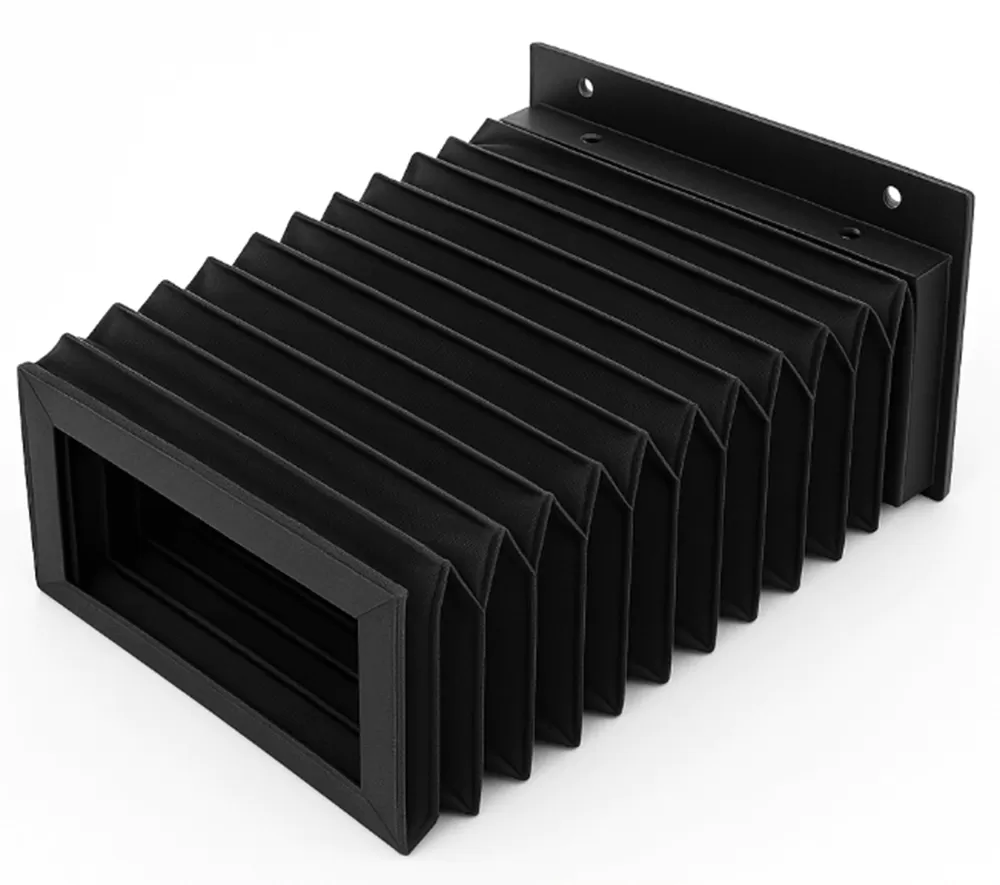
1. Mechanical Architecture & Material Science of Flexible Accordion Dust Covers
The fundamental operating principle of a flexible accordion dust cover relies on a foldable bellows geometry that extends and compresses while maintaining continuous contact with the moving machine element. Each pleat acts as a sealing barrier that deflects chips and directs fluids away from critical raceways. Engineering parameters that define performance include:
Pleat height / fold depth – determines maximum extension ratio (typically 5:1 to 8:1 extension-to-compressed length). Deeper folds allow longer strokes without exceeding the retracted envelope.
Base fabric laminate – multi-layer polyester fabric coated with polyurethane (PU) or PVC for oil resistance, hydrolysis resistance, and tensile strength up to 3500 N/5cm. High-performance grades incorporate PTFE impregnation for elevated chemical compatibility.
Internal reinforcement – injection-molded PA6 or aluminum alloy ribs spaced every 20–35 mm to withstand accidental impact from ejected chips, while remaining flexible enough for continuous cyclic bending exceeding 2 million cycles (ISO 1419 flex test).
Flange & mounting interface – die-cut aluminum or steel frames fitted with captive screws, magnetic strips, or hook-and-loop seals for tool-less removal during maintenance.
Proper selection of fabric thickness (0.6 mm to 1.8 mm) directly affects tear resistance. For high-velocity axes (up to 90 m/min) common in laser cutters and high-speed milling, a flexible accordion dust cover with reinforced weft yarns prevents flutter-induced fatigue. QUNHUI applies finite-element modeling to predict dynamic stress distribution across the bellows fold roots, significantly reducing field failure rates.
2. Core Industry Pain Points Solved by Custom Accordion Bellows
B2B production environments confront recurring challenges that a generic dust cover cannot mitigate. Below are the top five operational disruptions and how an engineered flexible accordion dust cover addresses each:
Rapid wear due to high-frequency short strokes – Pick-and-place units, gantry robots, and tapping machines often cycle thousands of times per shift. Standard rubber bellows crack at fold ridges. Our target solution uses cross-linked TPU layers that maintain elastic recovery at 2 Hz cyclic compression.
Limited retracted space inside machine enclosures – Many CNC retrofits or compact machining centers have less than 50 mm for cover storage. The flexible accordion dust cover can be designed with zero minimum compression (fully collapsed height as low as 12 mm) by employing overlapping pleats and thin-profile end plates.
Ingress of abrasive glass fiber or carbon dust – Composite machining generates fine dust that penetrates labyrinth seals. A flexible accordion dust cover equipped with double-lip sealing edges and high-density felt interlining achieves IP5X dust ingress protection per IEC 60529.
Coolant and oil degradation of elastomers – Chlorinated paraffins and ester-based lubricants attack ordinary nitrile. Polyurethane grades with ester-ether polyols provide 500+ hours of continuous immersion at 60°C without surface swelling or delamination, verified by QUNHUI material tests.
Difficult replacement leading to extended downtime – Modular cover designs with zipper-sealed seams or magnetic side strips cut replacement time from four hours to under thirty minutes. The flexibility of a flexible accordion dust cover also allows wrap-around installation without disassembling linear rails.
3. Application-Specific Configurations for Industrial Automation
Different automation segments impose unique mechanical and environmental demands. Below we examine three representative scenarios and the corresponding design adaptations of flexible accordion dust covers.
3.1. CNC Machining Centers – 3-Axis to 5-Axis Dynamic Sealing
Vertical milling centers and horizontal boring machines need protection for X, Y, Z axes, plus swiveling rotary tables. On long-travel X axes (exceeding 2 meters), telescopic steel covers are heavy, causing motor load penalties. A flexible accordion dust cover made of lightweight fabric reduces driven mass by 70% while providing continuous chip shedding. For 5-axis trunnion tables, bellows must accommodate angular misalignments up to ±15°, achieved by asymmetrical pleat geometry and elastic side gussets.
3.2. Industrial Robotics – Articulated Arm & 7th Axis Track Systems
Robotic linear tracks (seventh axis) operate in foundries or welding cells with spatter and scale debris. Standard flexible accordion dust covers risk snagging on robot cables. The alternative is a closed-loop design with integrated cable conduit fixation points and external hinged covers. For articulated arms where base rotation occurs, circular-shaped bellows with radial pleated conformation provides 360° protection without interfering with torque sensors.
3.3. Laser / Waterjet Cutting Gantries
High-energy processes generate fine dust and vapor. Here the flexible accordion dust cover must exhibit flame-retardant properties (UL94 V-2 minimum) and UV stability if exposed to reflected laser beams. QUNHHI utilizes halogen-free, antistatic fabric (surface resistivity < 10⁸ Ω/sq) to prevent dust accumulation and spark discharge, an important safety measure for aerospace component cutting lines.
4. Technical Parameters, Tolerances & Performance Validation
To assist engineering procurement teams, the table below summarizes quantified specifications for a typical industrial-grade flexible accordion dust cover. These values are validated through accelerated lifecycle tests per ISO 17840-2.
| Parameter | Typical Range | Test Method / Standard |
|---|---|---|
| Max. extension/compression ratio | 6:1 (customizable up to 10:1) | Dimensional measurement per ISO 1938 |
| Operating temperature (continuous) | -30°C to +110°C (PU coated) -15°C to +90°C (PVC based) | SAE J2236 thermal aging |
| Max. traverse speed (linear) | 120 m/min (with reinforced ribs) | High-cycle actuator testing |
| Fluid resistance | Mineral oil, synthetic ester, water-glycol | ASTM D471 immersion (168h @70°C) |
| Tensile strength (warp/weft) | ≥2400 N/50mm / ≥2100 N/50mm | DIN EN ISO 1421 |
| Dust ingress protection | IP5X / IP6X (with secondary lip) | IEC 60529 |
Such performance metrics ensure that a correctly specified flexible accordion dust cover withstands industrial contaminants while maintaining form factor integrity for at least five years in three-shift operations. For harsh applications like grinding or ceramic machining, additional sacrificial fabric layers can be incorporated without changing mounting frames – a design commonly executed by QUNHUI for global automation integrators.
5. Maintenance, Condition Monitoring & Replacement Strategy
Predictive maintenance of dust covers is often overlooked, yet cracked or misaligned accordion covers lead to linear system failure within weeks. Engineers should implement a quarterly inspection protocol:
Visual check for fabric delamination – look for separated coating layers at fold crowns. Minor surface abrasion is acceptable; exposed base fabric indicates imminent failure.
Compression test – manually compress the cover to its minimum height; smooth folding without buckling confirms intact internal supports.
Sealing lip wear measurement – gap larger than 0.5 mm between the lip and the moving surface degrades chip rejection. Replace immediately.
Replacement best practice – order a replacement flexible accordion dust cover with identical pleat count and mounting hole pattern. QUNHUI provides laser-scanned profile matching to avoid field modification.
When retrofitting older machines, consider upgrading mounting brackets from painted steel to stainless AISI 304 for higher corrosion resistance. Also ensure the cover’s dynamic clearance is at least 10 mm above any protruding cable track.
.webp?t=1778579537807 "风琴防护罩-(2)")
6. Custom Engineering Factors: Why Standard Covers Fall Short
Off-the-shelf bellows rarely satisfy the unique stroke-to-length ratio, side acceleration, and media exposure of a particular machine. Critical custom parameters include:
Non-rectangular exit shapes – many gantries have inclined cross-sections or variable width along the stroke. A flexible accordion dust cover can be produced with tapered pleats and stepwise frame adapters.
Integrated wiper seals – combining a polyurethane wiper with the outermost fold doubles scrap efficiency for abrasive powders.
Electromagnetic compatibility (EMC) shielding – for automated inspection equipment near sensitive sensors, covers can include conductive mesh layers to dissipate static charges.
Sanitary design for food/pharma automation – closed-corner folding, no undercuts, and smooth exterior surfaces prevent bacterial accumulation.
QUNHUI’s engineering team employs 3D CAD-based pleat simulation to predict compressed length and radiused fold behavior before sampling. This digital twin approach reduces iterations and delivers application-ready flexible accordion dust covers directly to system integrators.
7. Frequently Asked Questions (Engineering Focus)
Q1: Can a flexible accordion dust cover be used for vertical axis applications without sagging?
A1: Yes, special anti-sag designs are available. By integrating stiffer intermediate rib materials (PA66 + 30% glass fiber) and reducing the distance between pleat supports to 15 mm, the flexible accordion dust cover maintains planar alignment even on vertical Z-axes with 1.5 meters of travel. Additionally, side guide rails or embedded tension cords can be specified to prevent droop under gravity.
Q2: What is the maximum operating speed for longer stroke flexible accordion dust covers?
A2: For strokes exceeding 3 meters, the limiting factor is inertia-induced pleat hammering. With lightweight aramid fabric and carbon-reinforced ribs, the flexible accordion dust cover can sustain 90 m/min continuous and 180 m/min short traverse. Beyond that, contact QUNHUI for active air-venting systems that equalize internal-external pressure to avoid cover expansion.
Q3: How do I protect the cover from hot chips (up to 600°C) coming from turning operations?
A3: Standard polyurethane cannot withstand direct contact with red-hot chips. The solution is a dual-layer flexible accordion dust cover: an outer stainless steel mesh layer for impact deflection and an inner ceramic-fiber bellows for thermal insulation. This hybrid design maintains flexibility while offering short-term thermal protection up to 800°C.
Q4: Can the flexible accordion dust cover be retrofitted without removing the guide rail?
A4: Absolutely. Many retrofit kits utilize split-frame clamps or magnetic mounting strips that attach to the side of the rail. The cover itself is supplied with a zipper joint along one side, allowing it to wrap around the axis. After closing the zipper, the flexible accordion dust cover offers identical sealing performance to one-piece welded versions.
Q5: What is the expected lifecycle of the fold seam under continuous flexing?
A5: Lifecycle depends on stroke frequency and media. Under clean, dry conditions at 30 cycles/min, a high-grade flexible accordion dust cover exceeds 2.5 million cycles without leakage. In abrasive graphite dust at 60 cycles/min, we still measure 800,000 cycles before the first pinhole appears. RFQ should include the expected total cycles and contamination type for precise life prediction.
8. Value-Driven Protection for Advanced Manufacturing
Implementing a correctly engineered flexible accordion dust cover yields measurable returns: reduced unscheduled downtime, extended lubricant change intervals, and consistent surface finish by maintaining ball screw preload. When specifying covers for new machine builds or legacy retrofits, attention to pleat geometry, fabric chemical compatibility, and mounting rigidity separates reliable systems from field failures. Manufacturers such as QUNHUI combine ISO 9001:2015 certified production with application-specific engineering support, ensuring that each flexible accordion dust cover meets the exact dynamic and environmental profile.
To optimize protection for your automation axes, machining centers, or custom motion systems, request a detailed engineering consultation. Provide your stroke length, maximum velocity, cutting fluid type, and available mounting envelope – our specialists will respond with a tailored proposal and dimensional drawings.
Request Engineering Support & Quotation
For a comprehensive analysis or to order flexible accordion dust covers customized to your industrial application, contact the QUNHUI technical sales team. Provide your machine model, axis dimensions, operating conditions, and desired lead time. We can generate CAD proposals, material certificates, and lifecycle cost simulations (excluding TCO reporting per your request).
Direct inquiry line: qunnhui3286@gmail.com— Please use subject line “Flexible Accordion Cover – [Your Application]” to receive priority engineering review.
QUNHUI – Precision Protection for Global Automation Infrastructure.